Why it contains gluten
Soy sauce is made with wheat
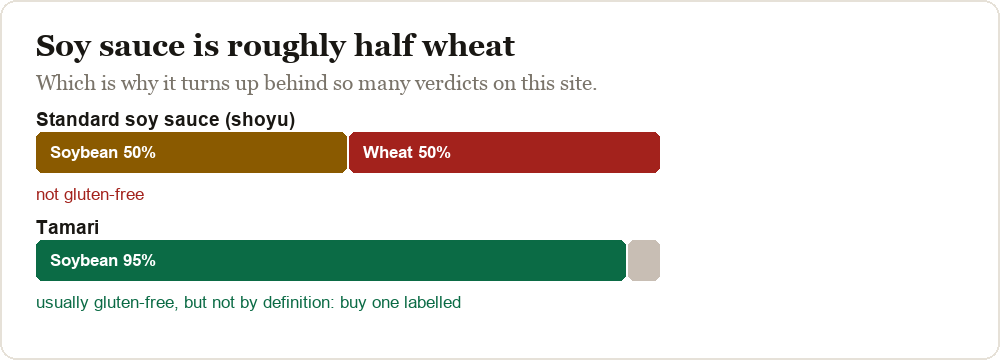
Standard brewed soy sauce is roughly half wheat by grain weight, which is why it turns up as the hidden gluten in food that has no obvious flour in it.
The short answer
Standard brewed soy sauce is roughly half wheat. San-J, which makes the wheat-free alternative, puts the figure on its own site: typical soy sauces contain "about 40-60% wheat," against a tamari made from "100% soybeans, with no wheat." Kikkoman Europe says outright that gluten-free status "cannot be guaranteed" for regular soy sauce. This is not a trace-contamination problem. It is an ingredient.
How it works
Japanese shoyu is brewed, not blended. Soybeans and cracked roasted wheat are inoculated with Aspergillus mould to make koji, mixed with brine into a mash called moromi, and left to ferment for months. The wheat is not a filler or a thickener. It is half the substrate, and it is what gives soy sauce its aroma and its slight sweetness. San-J's own comparison shows ordinary soy sauce as "About 50% Soy" and "About 50% Wheat."
Fermentation does degrade gluten, and that is not enough. Kikkoman Europe's FAQ states the position with unusual precision: "Gluten is broken down during the fermentation process, so the gluten content in the final product is minimal, but it cannot be guaranteed that it is gluten-free." Both halves of that sentence matter. The effect is real; the guarantee is absent. No producer of conventional shoyu certifies it under 20 ppm, and the analytical methods for fermented foods cannot reliably quantify what is left. A manufacturer telling you it cannot guarantee its own product is the strongest evidence available, and it points one way.
Tamari is the swap, and it is a genuine distinction rather than marketing. Tamari originated as the liquid drawn off miso production, brewed from soybeans with little or no wheat. San-J brews its tamari from 100% soybeans with no wheat and has it certified by the Gluten-Free Certification Organization. Kikkoman's Gluten-Free Soy Sauce takes the other route: it replaces the wheat with rice. Its ingredient list is "Water, Soybeans, Rice, Salt," and Kikkoman states it is "certified gluten-free by the Gluten Intolerance Group of North America (GIG)."
But tamari is not automatically gluten-free. "Tamari" describes a brewing style, not a legal composition, and some tamari is brewed with a small percentage of wheat. The distinction that actually protects you is the label, not the word. Beyond Celiac's guidance is to eat only soy sauce that is labelled gluten-free. Buy a bottle that says so, San-J and Kikkoman's gluten-free line both do, and stop parsing the style name.
Where this catches people
Soy sauce is the base layer of an enormous amount of savoury food, and almost none of it announces itself. These are the places the corpus keeps finding it:
- Eel sauce / unagi sauce / "sushi sauce." Soy sauce, mirin and sugar reduced to a glaze, a concentrated version of the thing that was already unreliable. It is drizzled over dragon rolls, tempura rolls and rice bowls by default.
- Teriyaki. Teriyaki is soy sauce with sugar. This is why teriyaki is the single riskiest flavour on a jerky shelf, a tofu pack or a chicken menu.
- Marinades and glazes generally. The Celiac Disease Foundation lists salad dressings and marinades among foods that "may contain malt vinegar, soy sauce, flour." Beef jerky is the clearest case: mainstream brands list soy sauce with wheat right in the sub-list and declare Contains: wheat.
- Seasoned seaweed. Plain nori, kombu and wakame have no gluten and no route to any. Korean seasoned gim, teriyaki seaweed snacks, furikake and goma wakame seaweed salad are glazed or dressed with wheat-brewed soy sauce.
- Japanese rice crackers. Senbei, arare and kaki no tane are rice, and the defining flavour is a soy sauce glaze or soy sauce powder. The rice is never the problem.
- Sausages, hot dogs and deli glazes, where soy sauce and malt extract are the two usual entry points into an otherwise clean meat panel.
- Chinese and Southeast Asian restaurant food broadly: hot and sour soup, stir-fry sauces, hoisin, oyster sauce, dumpling dips, fried rice. Assume soy sauce is in everything savoury until told otherwise.
- Tofu, when it is marinated, baked or braised. The Celiac Disease Foundation makes the point directly, tofu itself is gluten-free, but be cautious of "soy sauce marinades and cross-contact when eating out, especially when the tofu is fried."
The pattern worth internalising: soy sauce puts wheat into food that contains no flour, no batter and no bread. Every heuristic built on "does it look like bread?" fails here.
How to tell
On a packet. Look for soy sauce, shoyu, soya sauce or soy sauce powder anywhere in the ingredients, including inside a sub-list of a seasoning or marinade. On a US label, wheat is a major allergen, so a wheat-brewed soy sauce triggers a Contains: wheat declaration. That is the one place US labelling helps rather than hinders. If the panel names tamari, check whether the pack also carries a gluten-free claim; the good products say both.
In a restaurant, ask about the sauce, not the dish. "Is this gluten-free?" is too abstract for a busy kitchen. These four questions get real answers:
- "Does this have soy sauce in it?" Staff answer this accurately because it is an ingredient question, not a diet question.
- "Do you have a wheat-free tamari, or is there only one soy sauce in the kitchen?" Most kitchens have exactly one bottle, and the answer decides the meal.
- "Is the marinade or glaze made in-house, and does it start with soy sauce?" Teriyaki, eel sauce, ponzu and stir-fry sauces all do.
- "Can I see the bottle?" No chef minds. This resolves it faster than any description.
Carry your own. Bringing a small bottle of tamari to a Japanese restaurant is normal behaviour and solves the table-side soy sauce entirely. It does not solve the sauces already on the food.
The dedicated swaps. San-J Tamari (100% soybeans, GFCO certified) and Kikkoman Gluten-Free Soy Sauce (brewed with rice, GIG certified) are the two mainstream options, and either fixes teriyaki, ponzu, eel sauce, stir-fries and marinades at home in one substitution. Coconut aminos are the soy-free alternative, sweeter and less salty, so reduce added sugar when you cook with them.
Related questions
Is tamari always gluten-free? Almost always, but not by definition. Tamari is traditionally brewed with little or no wheat, and some brands still use a small percentage. Buy one that carries a gluten-free label or certification rather than trusting the word on the front.
Is Kikkoman soy sauce gluten-free? The standard traditionally brewed product is not. It is made with wheat, and Kikkoman Europe says gluten-free status cannot be guaranteed for it. Kikkoman's separate Gluten-Free Soy Sauce is a different product, brewed with rice instead of wheat and certified gluten-free. They sit next to each other on the shelf.
Isn't the residual gluten in soy sauce very low? Often, yes, fermentation genuinely breaks gluten down, which is why many people with non-celiac gluten sensitivity tolerate a dip of ordinary shoyu. That is a personal calibration, not a safety finding. For celiac disease the relevant fact is that no conventional producer will certify the result, and a reduced sauce concentrates whatever was there.
Is soy sauce a problem for a wheat allergy? Yes, and more simply than for celiac disease. Fermentation does not make an allergen disappear, and wheat-brewed soy sauce must be declared as wheat on a US label. Avoid conventional soy sauce and everything built on it.
Is soy itself gluten-free? Yes. Soybeans, edamame, plain tofu, soy milk and soy lecithin are all gluten-free. The confusion is purely linguistic, "soy sauce" is a wheat product with soy in the name.
What about hoisin, oyster sauce and Worcestershire? Hoisin and oyster sauce are commonly wheat-containing and are frequently built on or alongside soy sauce. Worcestershire is a separate risk with the same shape: UK-market bottles are often made with malt vinegar, which is barley. Check each one on its own page rather than assuming the tamari swap covers them.
Does sushi rice or seaweed contain soy sauce? Plain sushi rice is seasoned with rice vinegar, sugar and salt, and plain nori is just the alga. Both are fine. The soy sauce arrives with the eel sauce, the spicy mayo, the ponzu and the dipping dish, plus imitation crab, which usually contains wheat starch, and tempura, which is battered.
How we checked
| Source | Tier |
|---|---|
| San-J, Our Tamari, "We make ours using 100% soybeans, with no wheat"; typical soy sauces "contain about 40-60% wheat"; comparison shows ordinary soy sauce as "About 50% Soy" and "About 50% Wheat"; "San-J Tamari is certified gluten-free by the Gluten-Free Certification Organization" | A |
| Kikkoman Europe, FAQ, "Gluten is broken down during the fermentation process, so the gluten content in the final product is minimal, but it cannot be guaranteed that it is gluten-free"; recommends its Tamari Gluten-free Soy Sauce instead | A |
| Kikkoman USA, Gluten-Free Soy Sauce, "made from rice instead of wheat"; "certified gluten-free by the Gluten Intolerance Group of North America (GIG)"; ingredients "Water, Soybeans, Rice, Salt" | A |
| Celiac Disease Foundation, Sources of Gluten, "traditional soy sauce" listed among foods that contain gluten; "Soy sauce (though tamari made without wheat is gluten-free)"; tofu is gluten-free "but be cautious of soy sauce marinades and cross-contact when eating out, especially when the tofu is fried" | B |
| Beyond Celiac, Is Soy Gluten-Free?, eat only soy sauce labelled gluten-free | B |
Overall source tier: A. Two manufacturers speak directly to the gluten question about their own products, Kikkoman Europe declining to guarantee its conventional soy sauce, and San-J and Kikkoman USA both publishing certified gluten-free alternatives with the composition spelled out. That is as good as sourcing gets on an ingredient mechanism, and it is corroborated by two national celiac organisations.
Last verified: 13 August 2026. Producers reformulate and relabel without notice, and restaurant kitchens change bottles without telling anyone. The label in your hand, and the bottle the kitchen shows you today, outrank this page.