Why it contains gluten
Why barley malt is in your cereal (and what it means)
Malt is barley, barley is a gluten grain, and in the US barley never has to be named on the label, so "malt" is the whole warning you get.
The short answer
Malt is barley. Malting is sprouting and kilning a grain to develop enzymes and flavour; nothing in that process removes gluten, because nothing in it is trying to. The Celiac Disease Foundation lists malt, malt extract, malt flavor and malt syrup among ingredients that are not safe on a gluten-free diet. In the US, barley is not a declarable allergen, so "malt" in the ingredient list is often the only warning you get.
How it works
Barley grain is steeped in water until it germinates, then kilned to stop growth. Germination switches on enzymes that convert starch into fermentable sugars, and kilning develops the toasted, caramelised flavour everyone recognises as "malty." The output is sold in several forms, and they are all barley:
| Name on the label | What it is | Gluten |
|---|---|---|
| Malt / malted barley / malted barley flour | The malted grain itself, whole or milled | Yes |
| Malt extract / barley malt extract | Malt steeped in water and the liquid concentrated | Yes |
| Malt syrup | The same concentrate, sold as a sweetener | Yes |
| Malt flavour / malt flavoring | A malt-derived flavouring, almost always barley | Yes |
| Malt vinegar | Vinegar fermented from malted barley, fermented, not distilled | Yes |
| Malted milk | A powder of malted barley, wheat flour and milk | Yes |
| Maltodextrin | Despite the name, not made from malt. Coeliac UK: "maltodextrins are not produced from, nor do they contain barley malt" | No |
| Maltose, maltitol | Sugars named for malt chemistry, not made from barley malt | No |
The Celiac Disease Foundation's list is explicit: "Malt in various forms including: malted barley flour, malted milk or milkshakes, malt extract, malt syrup, malt flavoring, malt vinegar." Coeliac UK puts barley in the flat "not gluten free" column, "including products that contain malted barley such as malted drinks, beers, ales, lagers and stouts."
Why it is in so many products. Malt does three jobs cheaply, which is why it turns up in categories that look nothing alike. It flavours: toasted, slightly sweet, and it deepens cocoa, hence chocolate, chocolate powders and malted milk drinks. It sweetens and browns in one ingredient, which is why malt syrup and malt extract coat breakfast cereals and crisped rice. And it supplies fermentable sugar: brewing needs starch converted to sugar, and malted barley does the conversion itself, which is the whole reason beer, ale, lager, stout and flavoured malt beverages are a gluten problem at all.
Crisped rice is the sleeper. Barley malt is the standard flavouring in commercial crisped rice, which is why a chocolate bar built on rice, a gluten-free grain, still fails. If you see "crisped rice" or "crisp rice" in a bar, assume malt until a sub-list proves otherwise.
Where this catches people
The labelling gap is the whole story, and it is a US-specific one.
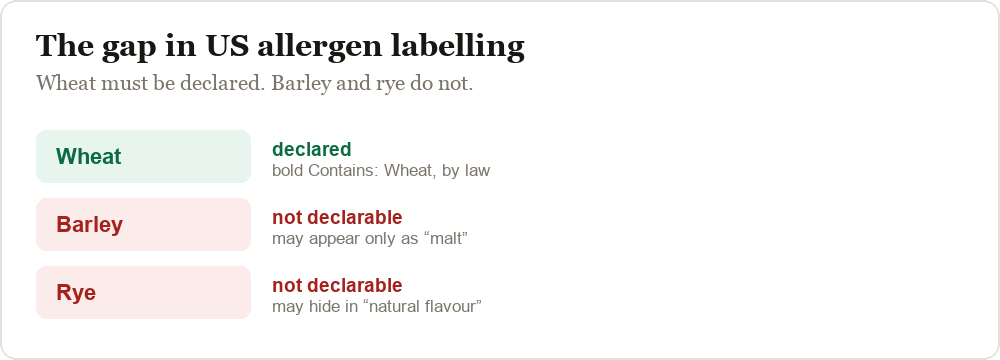
US law requires declaration of nine major food allergens: milk, eggs, fish, Crustacean shellfish, tree nuts, peanuts, wheat, soybeans and sesame. Barley is not on that list. Neither is rye. So a cereal containing wheat gets a bold Contains: Wheat, and a cereal containing barley malt gets nothing. A shopper who has trained themselves to read the allergen box sees a clean panel and reasonably concludes the product is safe. The only clue is the word "malt" buried in the ingredient list, and because barley triggers no allergen declaration, a malt-derived flavouring can legally sit inside an unsourced "natural flavour."
One calibration on that last point: it is a legal gap rather than a common practice, most US manufacturers do write "malt flavor," and the Celiac Disease Foundation's own label guide lists "natural flavors" among ingredients it treats as safe. Worry about an unsourced flavouring mainly where a barley-containing sibling product exists in the same range.
The UK and EU close that gap. Retained EU Regulation 1169/2011 lists "Cereals containing gluten, namely: wheat (such as spelt and khorasan wheat), rye, barley, oats or their hybridised strains, and products thereof" as a declarable allergen, and Article 21 requires the allergen name to be "emphasised through a typeset that clearly distinguishes it from the rest of the list of ingredients." That is why a UK pack says BARLEY Malt Extract in capitals and the US equivalent says only "malt flavor."
Hence the commonest failure in the corpus: the same brand, honest in one market and silent in the other. US Frosted Flakes lists "malt flavor"; UK Frosties lists barley malt flavouring with Contains Barley on the pack. Both are barley. Only one pack tells you.
Where else it lands. Cereals with a "clean" base grain: corn flakes, rice crisps, honey-nut clusters. Chocolate bars with crisped rice. Chocolate drink powders and malted milk drinks. Brown sauces, steak sauces, dressings and marinades, which the Celiac Disease Foundation warns "may contain malt vinegar, soy sauce, flour." Beer and every flavoured malt beverage. Spice blends and seasoned crisps.
How to tell
Read the ingredient list, not the allergen box. On a US label the allergen box cannot help you here by design. Scan the ingredients for six words: malt, malted, malt extract, malt syrup, malt flavor, malt vinegar. Any of them means barley.
Ignore maltodextrin, maltose and maltitol. They share a prefix and nothing else. Coeliac UK is explicit that maltodextrin is not made from barley malt, and adds that even wheat-derived maltodextrin is processed to remove the gluten.
"Wheat-free" is not "gluten-free." This phrase does real damage in the cereal aisle. It is often literally true and completely irrelevant.
The gluten-free label outranks the ingredient list, and only in one direction. Under FDA rules a food containing barley malt cannot carry a gluten-free claim in the US at all, so a US pack that names malt is settled. In the UK and EU the position is subtler, and it is the one genuine nuance in this whole subject. Barley must be declared however little is used, so a UK product can name barley malt extract and still test under the 20 ppm legal threshold for a gluten-free claim. Coeliac UK's grains guidance says exactly this: barley malt extract sits in its "need to check" column, because "some breakfast cereals containing barley malt extract are suitable if they are labelled gluten free."
So the UK rule is: the ingredient list cannot clear a malt-containing product, and the gluten-free label can. No label, no clearance, the theoretical possibility that a given product is under 20 ppm is not evidence that it is.
When the flavouring is unsourced, ask. One email settles it: "Is the natural flavour derived from wheat, barley or rye?" Naming barley matters, because a manufacturer answering an allergen question will answer about wheat.
Related questions
Is malt vinegar gluten-free? No. It is fermented from malted barley and never distilled, so the barley protein is still there, the Celiac Disease Foundation names malt vinegar among gluten-containing forms of malt. Distilled (white) vinegar is a different product and is gluten-free. This catches people on brown sauces, chip-shop vinegar, British-market horseradish and creamed sauces, salad dressings and some crisp seasonings.
Is maltodextrin gluten-free? Yes. Coeliac UK states that "despite the name, maltodextrins are not produced from, nor do they contain barley malt," and that even wheat-based maltodextrin is processed to remove gluten. It is one of the most over-avoided ingredients on the shelf.
How much gluten is actually in a spoonful of barley malt extract? Nobody publishes a per-product figure, and it is the wrong question. The legal threshold for a gluten-free claim is 20 ppm and there is no established safe daily dose for celiac disease. Presence decides it, not quantity, except in the UK/EU case above, where a manufacturer has tested the finished product and earned the label.
Is malt always from barley? For labelling purposes, treat it as yes. Where a manufacturer says its malt could come from corn, barley or a blend and that it cannot specify per product, that is disqualifying either way: an ingredient whose gluten status the manufacturer cannot confirm is not one a celiac diet can accommodate.
Does "brewer's yeast" mean barley? It is on the Celiac Disease Foundation's gluten-containing list, because brewer's yeast is a by-product of beer brewing and carries barley residue. Nutritional yeast is a different product and is not the same risk.
How we checked
| Source | Tier |
|---|---|
| Celiac Disease Foundation, Sources of Gluten, "Malt in various forms including: malted barley flour, malted milk or milkshakes, malt extract, malt syrup, malt flavoring, malt vinegar" | B |
| Celiac Disease Foundation, 2024 Food Label Reading Guide, "The following ingredients are NOT safe on a gluten-free diet: Malt, Malt extract, Malt flavor, Malt syrup." Maltodextrin, maltose, natural flavors and distilled vinegar are listed as safe | B |
| Coeliac UK, Grains, "Not gluten free: Barley (including products that contain malted barley such as malted drinks, beers, ales, lagers and stouts)"; "Need to check: Barley malt extract (some breakfast cereals containing barley malt extract are suitable if they are labelled gluten free)" | B |
| Coeliac UK, Living gluten free FAQs, "The law on gluten free must contain no more than 20 ppm"; "maltodextrins are not produced from, nor do they contain barley malt" | B |
| Beyond Celiac, Is Barley Gluten-Free?, barley malt and malt extract are not gluten-free | B |
| FALCPA 2004, as amended by the FASTER Act 2021, the nine major food allergens are milk, eggs, fish, Crustacean shellfish, tree nuts, peanuts, wheat, soybeans and sesame. Barley and rye are not among them. Cited by statute: FDA's page 404s and no stable replacement URL could be verified | C |
| Regulation (EU) No 1169/2011, Annex II and Article 21, "Cereals containing gluten, namely: wheat (such as spelt and khorasan wheat), rye, barley, oats or their hybridised strains, and products thereof"; allergens "emphasised through a typeset that clearly distinguishes it from the rest of the list of ingredients" | C |
| TTB Ruling 2020-2, reproduces FDA's gluten-free definition at 21 CFR 101.91: a food may not bear the claim if it contains an ingredient that is a gluten-containing grain, and unavoidable gluten must be below 20 ppm | C |
Overall source tier: B. All three national celiac organisations name malt and its derivatives as gluten-containing, two of them in a published list rather than in prose. The US/UK labelling asymmetry rests on the regulations themselves, which is tier C, a regulatory classification, not a manufacturer statement. No tier-A source exists for a mechanism rather than a product.
Last verified: 13 August 2026. Manufacturers reformulate without notice, and the same brand often runs different recipes in different markets. The packet in your hand outranks this page, and if it is American, read the ingredient list rather than the allergen box.